The Australian Government's Cheaper Home Batteries Program has rapidly and substantially increased the uptake of both rooftop solar systems and residential batteries in Australia. Unsurprisingly, EWON has started seeing an uptick in complaints, with some clear themes emerging.
Cheaper Home Batteries Program
Launched on 1 July 2025, the Cheaper Home Batteries Program provides a discount of up to 30% on the upfront cost of installing a range of small-scale battery systems (5 kWh to 100 kWh) for households, small businesses and community organisations. The Clean Energy Council’s Rooftop solar and storage report - July-December 2025 stated that over 180,000 batteries were sold in Australia in that period, four times the number sold in the same period in 2024. According to the Clean Energy Regulator, NSW was the state with the most approved solar battery installations.
In late 2025, the Australian Government announced a four-year extension to the program. However, rebates were reduced to favour smaller battery arrays from 1 May 2026, with further reductions in rebates occurring every six months in anticipation of battery prices lowering.
EWON complaints
EWON defines rooftop solar and batteries, along with electric vehicle (EV) chargers, as consumer energy resources (CER).
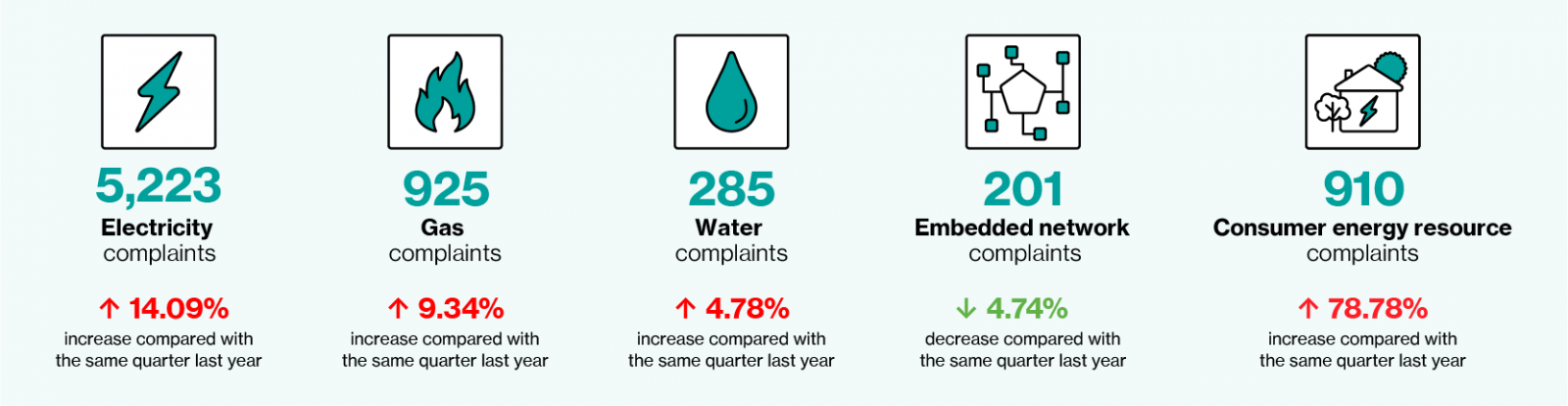
In the April - June 2026 quarter, EWON experienced a 79% increase in CER-related complaints compared to the same period in 2025. The percentage of electricity complaints involving CER increased from 11% to 17%.
|
|
Apr 25 - Jun 25 |
Jul 25 – Sep 25 |
Oct 25 – Dec 25 |
Jan 26 – Mar 26 |
Apr 26 – Jun 26 |
|---|---|---|---|---|---|
|
Number of CER complaints |
509 |
653 |
763 |
911 |
910 |
|
Percentage of electricity complaints |
11% |
11% |
14% |
17% |
17% |
EWON’s role
EWON resolves complaints about our members including all authorised energy retailers. If one of our members sells and/or arranges installation of solar product or services, EWON can resolve the complaint. This is recognised by the NSW Government through their proposed remake of the Electricity Supply (General) Regulation, formally expanding EWON's remit to hear consumer complaints about energy saving technologies, including rooftop solar and home batteries.
However, there is no current legal requirement for non-energy retailer installers or sellers of rooftop solar or residential batteries (or other CER products or services) to become members of EWON. If someone comes to EWON with a complaint about a solar product or service that has been installed or sold by an entity that is not a member of EWON, we log the complaint as “out of jurisdiction” and refer them to NSW Fair Trading.
For more information about EWON’s observations and positions on the disadvantage experienced by customers who cannot access EWON’s dispute resolution services, see:
-
submissions such as EWON’s joint submission with EWOV, EWOQ and EWOSA to the Commonwealth Government’s Better Energy Customer Experience Reform.
EWON complaints
We reviewed complaints about batteries received in FY26, both in and out of jurisdiction, and identified recurrent themes including:
-
batteries not delivering expected electricity bill savings
-
other high billing complaints, for example, customers finding that the increases in fixed charges on their electricity bill have outweighed the reduction in variable charges gained through installing a battery
-
marketing pressure and/or misleading sales practices, including:
- customers being sold a product not suited to their individual circumstances/needs
- over-promising of the benefits of a battery
- customers experiencing vulnerability being sold unsuitable or unaffordable products
-
problems replacing a basic meter with a smart meter (required to gain the benefits of the battery)
-
battery faults, defects and warranty issues
-
onboarding, configuration and system integration issues
-
batteries not installed within agreed timeframes, or only partially installed
-
disputes over retailer market contracts aimed at customers with batteries, such as eligibility criteria
-
customer service issues, such as not providing clear explanations of solar/battery impacts on billing.
Complaint themes relating specifically to the Cheaper Home Batteries Program include:
-
customers unhappy they were not eligible when battery installation was finalised after 1 July 2025, based on the fact that the testing and certification for compliance with electrical safety regulations was performed before 1 July 2025
-
installation delays meaning the amount of rebate to which the customer is entitled is reduced or at risk of being reduced
-
lack of available battery stock
-
solar/battery retailer not applying the rebate in a timely manner.
Case studies
Case study one
 Battery fault withing warranty period
Mali purchased a bank of batteries through an energy retailer a few years ago. She was still making monthly payments to pay off the product when she started to experience faults shorting out the batteries. The energy retailer asked her some questions about the battery setup and, on the basis of her answers, advised the installation may not have been completed properly. However, the energy retailer then stopped replying to her emails about the issue. As she understood that the batteries were still under warranty, Mali contacted the battery manufacturer but they told her they could not assist and she should speak to her energy retailer.
We referred Mali’s complaint to a senior team at the energy retailer. Mali returned when the complaint was still unresolved, and EWON investigated.
The energy retailer’s installer conducted a site visit and found a fault with the battery. The energy retailer confirmed the battery was still in warranty and put in a warranty claim with the manufacturer. The energy retailer arranged another visit to take photos for the warranty claim. The energy retailer advised it would arrange for a replacement battery to be installed, and then review Mali’s billing.
Case study two
High bill following battery installation
Duncan installed rooftop solar and a battery in February 2026. He received an electricity bill for $200 for January to March 2026, and thought it was too high, assuming that for half the period he would have been drawing power from his battery rather than the grid.
Duncan tried to contact the retailer multiple times for an explanation of the bill. He received an automated message advising that the retailer was experiencing high call volumes and would call back. Duncan did not receive any callbacks.
EWON referred the complaint to a senior team at the energy retailer. Duncan returned to EWON when he had not heard from the retailer within the requested five business days.
EWON investigated Duncan’s complaint and found that most of the disputed charges arose in the period before the rooftop solar and battery were installed. Usage data showed a clear decline in usage drawn from the grid from February 2026 onwards, with further reductions in March 2026 as the battery became fully operational. Analysis of Duncan’s usage patterns showed that once the battery was fully operational, he was typically drawing less than 1 kWh per day from the grid. The retailer offered to apply a credit of $50 for the communication delays, which Duncan accepted.
Case study three
Battery fault impacts cost of EV charging
Gabriel received an electricity bill from his retailer for $400 with average daily usage of 18 kWh. He considered this to be a typical bill in line with his usage habits. His next bill for the June to September 2025 quarter was $1,900, with average daily usage of 58 kWh. Most of the usage was from EV charging. He had recently installed a 25 kWh solar battery, but it stopped operating properly from late July 2025.
The installer confirmed a fault and corrected it in September 2025. Due to the fault, he was unable to store excess solar energy and was reliant on grid imports at peak rates. He still considered the bill to be unreasonably high, as he was enrolled in the retailer's EV program which provided EV charging under specific conditions. He had followed the charging condition rules, but had not received the credits he expected, so he thought there must be a fault in the retailer’s app. Gabriel’s calculations were that his bills should be $1,000 cheaper if all credits were applied.
EWON referred the complaint to a senior team at the energy retailer, but Gabriel returned to EWON as he was not satisfied with the retailer’s response. The retailer had provided Gabriel with charging logs and offered a goodwill credit of $500 but Gabriel continued to be of the view that the bill should be $1,000 cheaper.
EWON investigated the complaint. The retailer advised that the meter data indicated the customer had received the appropriate credits. To resolve the complaint, the retailer offered a goodwill credit to $750, with EWON to conduct a detailed billing and meter data review if the customer declined the credit.
The customer accepted the credit to resolve the complaint, with the expectation that the issue would not recur now that his battery was functional again.